

If you have been watching the XXV Olympic Winter Games this week, you have seen more than just incredible athleticism. You have seen physics in its most extreme form. From the skating rinks of Milan to the ski jumps in Predazzo, the world’s best athletes are currently proving that mastering a textbook is not so different from mastering the ice.
At ConnectPrep, we believe that when students see the “why” behind the formulas, their potential shifts into high gear. Here is how the 2026 Winter Games, currently unfolding today on Friday, February 13, are bringing your science curriculum to life.
Ilia Malinin and the Angular Momentum Mastery
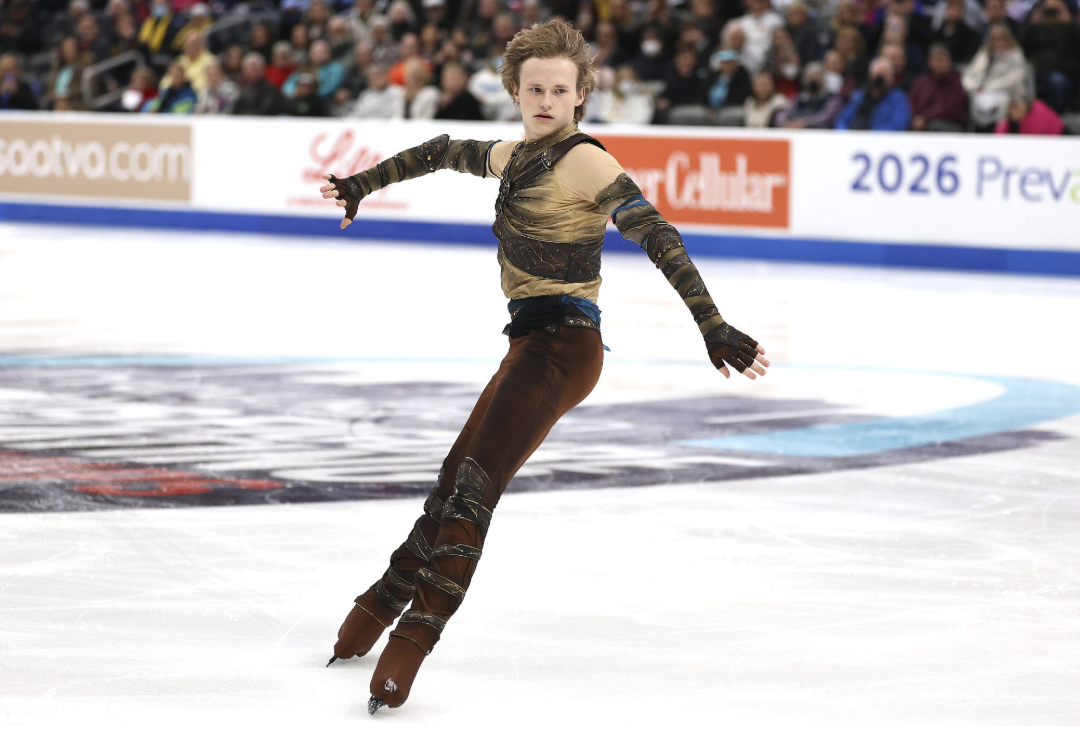
American sensation Ilia Malinin recently led Team USA to a historic gold medal in the team event. Known as the “Quad God,” Malinin’s performance is a masterclass in rotational mechanics.
The Physics of the Win: To land his signature quadruple jumps, Malinin must rotate roughly 10 times faster than a vinyl record player. Students study the Conservation of Angular Momentum:
L = I * ω
When Malinin pulls his arms tight to his chest, he reduces his moment of inertia (I), which causes his angular velocity (ω) to skyrocket.
Physicists at Boston University calculated that Malinin has to resist nearly 200 pounds of centrifugal force per arm during these spins. If his arms were to fly out even a few inches, his rotation would slow down instantly, and he would fail to land. He won by mastering the ability to maintain a perfectly tight “pencil” shape under immense physical pressure.
Jordan Stolz: Engineering the “Frictionless” Glide
American speed skater Jordan Stolz set a new Olympic record this week in the 1000m with a time of 1:06.28. At these speeds—reaching over 35 mph—air resistance is a literal wall of force.
The Physics of the Win: Stolz’s victory is a result of minimizing Fluid Drag. By maintaining a perfectly horizontal torso, he reduces his frontal surface area, which directly lowers the Drag Force:
Fd = ½ * ρ * v² * Cd * A
Stolz treats skating like an engineering problem, obsessing over blade curvature and ice density. His win was secured by a devastating final lap where his aerodynamic efficiency allowed him to maintain speed while his competitors “faded” due to the energy cost of fighting air resistance. Read more about his record-breaking run here.
Choi Gaon: Managing Mechanical Energy
Yesterday, the sports world saw a massive upset as 17-year-old Choi Gaon of South Korea stunned defending champion Chloe Kim to take the halfpipe gold.
The Physics of the Win: To get “massive air,” boarders must maximize their velocity at the bottom of the pipe. Every ounce of Kinetic Energy (Ek = ½mv²) at the base is converted into Gravitational Potential Energy (Ep = mgh) at the peak of the jump.
Choi used a technique called Pumping Mechanics to win. By crouching down in the “flat” of the pipe and explosively standing up as she hit the curve, she did “work” against the centrifugal force, which added energy to her run. This extra kinetic energy allowed her to fly higher (amplitude) than anyone else, giving her the “air time” needed to complete more complex rotations.
Why This Matters for Your Student
The athletes in Milano Cortina are not “breaking” physics. They are optimizing it. Whether your student is aiming for an Olympic podium or an A in AP Physics, the secret is the same: consistency, data, and technical precision.
At ConnectPrep, we specialize in helping students bridge the gap between abstract concepts and real-world results. Our expert tutors use these same principles of precision and data-driven instruction to help students master STEM subjects, excel in Test Prep, and secure admissions to top-tier universities.
Don’t let your student’s academic goals slide. Reach out to us today to schedule a consultation and see how we can help them achieve their own “Gold Medal” success.
Call us: 914-288-5718
Email us: info@connectprep.com
Visit us: www.connectprep.com
