
Private School Admissions
For decades, the honest answer to “ISEE or SSAT?” depended partly on which organization a family’s schools were aligned with. Since March 2026, there is only one organization.

Updated August 2026 · 9 minute read
Quick Answer
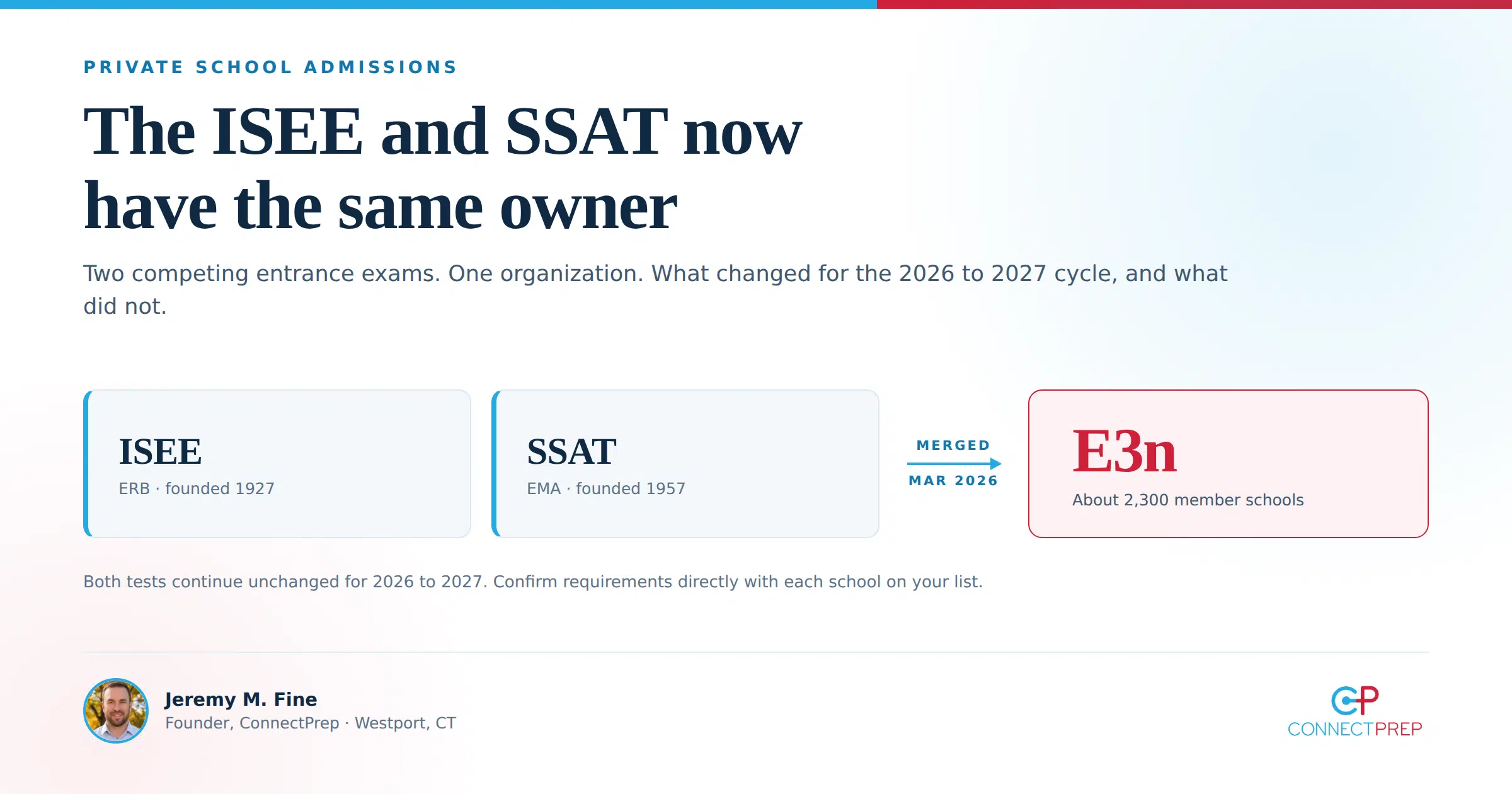
ERB and the Enrollment Management Association merged on March 2, 2026 to form a single nonprofit called E3n. ERB owns the ISEE. The Enrollment Management Association owns the SSAT. Both tests continue to be offered, in their current formats, for the 2026 to 2027 admissions cycle.
No format change, no scoring change, and no move to computer adaptive testing has been announced for either exam.
Key Facts
| What happened | ERB and the Enrollment Management Association merged |
| Date completed | March 2, 2026 |
| New organization | E3n, short for Enroll. Educate. Excel. |
| Chief executive | Mike Flanagan |
| Member schools | Approximately 2,300 |
| Tests affected | ISEE (from ERB) and SSAT (from the Enrollment Management Association) |
| Changes to either test | None announced |
| Effect on 2026 to 2027 applicants | None |
| Last verified | August 6, 2026 |
What is the E3n merger?
E3n is the nonprofit organization created when ERB and the Enrollment Management Association completed their merger on March 2, 2026. The name stands for Enroll. Educate. Excel. E3n is led by chief executive Mike Flanagan and serves roughly 2,300 member schools. It now owns both major independent school entrance exams.
Here is the background on each organization.
ERB, the Educational Records Bureau, was founded in 1927. ERB owns the Independent School Entrance Examination, known as the ISEE.
The Enrollment Management Association was founded in 1957 as the Secondary School Admission Test Board. That organization owns the Secondary School Admission Test, known as the SSAT.
The two organizations announced their intent to merge in September 2024. The transaction closed on March 2, 2026.
That is the entire event. The E3n merger is a corporate consolidation, not a testing change. But it resolves a structural fact that shaped independent school admissions for a very long time.
Why did two separate tests exist?
Two nearly identical entrance exams existed because two competing organizations built them, not because schools needed two different measures. The SSAT grew out of a consortium of boarding schools. The ISEE grew out of an educational assessment organization that had served day schools since the 1920s. Each built its own network of member schools, test centers, and scoring conventions.
Families ended up straddling both systems because their school lists straddled both networks.
The practical consequence has been genuinely frustrating for parents. Two registrations. Two fee structures. Two score reporting systems. Two sets of practice material. And a real strategic question about which exam to sit, a question sometimes answered with “both,” which is the worst outcome for a twelve year old.
One owner should eventually make that simpler. The word carrying the weight in that sentence is eventually.
Does the merger change the ISEE or SSAT for 2026 to 2027?
No. Neither the ISEE nor the SSAT has changed. Both tests are still offered, in their existing formats, with existing scoring. Registration systems remain separate. Schools still specify which exam or exams they accept. A student applying in the 2026 to 2027 cycle should plan exactly as they would have before the merger.
| Question | Answer for 2026 to 2027 |
|---|---|
| Does the ISEE still exist? | Yes, unchanged |
| Does the SSAT still exist? | Yes, unchanged |
| Has either test’s format changed? | No |
| Has either become computer adaptive? | No |
| Are the registration systems merged? | No. They remain separate |
| Do schools still specify which test they accept? | Yes |
| Has scoring changed? | No |
| Are existing scores still valid? | Yes |
Confirm current requirements directly with each school on your list before finalizing a testing plan. We do exactly this with every ConnectPrep family during intake.
One clarification worth making
Will the ISEE and SSAT eventually combine?
Nothing has been announced. E3n’s stated plan is to continue offering both the ISEE and the SSAT in their current forms. Anyone predicting a merged exam or the retirement of one test is speculating. Families should plan for the testing landscape exactly as it exists today.
That said, the strategic logic is worth understanding.
When one organization owns two directly competing products, there are three long run possibilities: run both indefinitely, retire one, or build a new instrument that replaces both. E3n has chosen the first for now.
That is almost certainly correct for the next cycle or two. Schools have built admissions processes around specific exams and specific score conventions. You do not disrupt that on eighteen months of notice, and E3n has given no indication that it intends to.
But it is worth watching for one straightforward reason. Maintaining two full scale standardized assessments means funding two item banks, two psychometric programs, two test center networks, and two security operations. The usual financial argument for merging two nonprofits is that you stop paying for things twice.
What we tell families planning right now: plan for the tests as they exist, because that is what your child will sit. If you are mapping a multi year plan for a younger child, such as a fourth grader you expect to apply for ninth grade, hold your testing assumptions loosely and avoid heavy test specific preparation years in advance. That was sound advice before the merger. It is better advice now.
Why families come to ConnectPrep for private school testing
ConnectPrep is founder led and one on one. We prepare students for both the ISEE and the SSAT, we verify what each school on your list actually requires rather than trusting a directory, and we build a testing plan around your application deadline instead of a generic curriculum. Backed by our founder’s more than 20 years of elite test preparation across Fairfield County and the New York metro area.
How should families choose between the ISEE and the SSAT?
Let the school list decide first, then confirm each school’s policy by phone, then compare diagnostic results on both exams. The merger does not change this framework. Most students score within a similar band on both tests, but a meaningful minority perform noticeably better on one, and those are the students for whom the choice matters.
Work through these three steps in order.
Step 1. Build the school list before choosing a test. Find out what each school accepts. Most independent schools in Fairfield County and the New York metro area accept both exams, but not all do, and the exceptions are exactly why you ask. A school that accepts only one exam settles the question immediately.
Step 2. Call the admissions office rather than reading the website. Five questions are worth asking:
- Do you accept both the ISEE and the SSAT, and do you have a preference in practice?
- What is your score deadline, and is that the test date or the score release date?
- How many times may a student test, and do you see every score or only the ones we send?
- Do you require or accept the Character Skills Snapshot?
- Has anything about your testing policy changed for this cycle?
That last question has become necessary. Independent school testing policy has been in motion for several years and websites lag reality.
Step 3. Compare diagnostics, then commit to one exam. Once the school list has narrowed the field, the decision comes down to how your child actually performs. The two exams differ in their verbal sections and in how they treat guessing. A timed diagnostic on each is worth more than any general comparison article, including this one.
Are private schools still requiring entrance exams?
Independent school testing policy has split. The most selective boarding and day schools, including Phillips Academy Andover, Phillips Exeter Academy, Groton School, Horace Mann School and Trinity School in New York, continue to require testing. A meaningful group of strong schools including Choate Rosemary Hall and Concord Academy have moved to test optional. A small number no longer consider scores at all.
Here is the part families most often miss.
At a test optional school, the students who submit scores are overwhelmingly the students with strong scores. That pushes the school’s reported score range upward. A test optional policy does not mean testing is irrelevant at that school. It means a strong score still helps and a weak score no longer hurts.
For a student who tests well, test optional schools represent an opportunity, not a reason to skip the exam.
Locally, testing remains firmly in place at a number of schools. Greenwich Academy, for example, still requires the ISEE or the SSAT across its middle and upper school application groups. Verify your own list rather than generalizing from ours.
What is the Character Skills Snapshot?
The Character Skills Snapshot is a 25 to 30 minute online assessment from E3n that measures seven noncognitive traits: initiative, intellectual engagement, open mindedness, resilience, self control, social awareness, and teamwork. It costs $30 bundled with SSAT registration or $60 on its own, and a student may take it once per testing year.
Should your child take it? For most families, only if a school on their list asks for it. Adoption remains limited. E3n reports that hundreds of schools use the Snapshot out of more than 2,300 member schools, with roughly 100,000 Snapshots completed cumulatively since 2017. That is a modest number spread across nine years.
Can a student prepare for it? Not in any meaningful sense, and families should be skeptical of anyone selling preparation for it. The Snapshot uses a forced choice format specifically designed to resist coaching. The most useful guidance you can give a child is to answer honestly rather than guessing what a school wants to hear, which happens to also be the strategy that produces the best result.
Frequently asked questions
Do I need to retake a test because of the E3n merger?
No. Scores earned before the merger remain valid, and both the ISEE and the SSAT continue to be administered and reported normally.
Will the ISEE and SSAT combine into one test?
Nothing has been announced. E3n’s stated plan is to continue offering both exams as they are. Whether that holds over a longer horizon is genuinely unknown.
My child already registered for the SSAT. Does anything change?
No. Registration, test dates, and score reporting are all proceeding normally.
Should my child take both the ISEE and the SSAT?
Usually not. Sitting two different entrance exams in one fall is a heavy load for a middle school student, and the benefit is small unless the school list genuinely splits between the two. Take a diagnostic on each, choose the stronger result, and invest the time you save in preparing properly for that one exam.
Is the ISEE now computer adaptive?
No. The exam that became computer adaptive in 2026 is the SHSAT, New York City’s specialized high school admissions test. The ISEE has not changed.
When should we start preparing for the ISEE or SSAT?
For most students, eight to ten weeks of consistent preparation before the test date is right, beginning after a diagnostic rather than before one. Starting much earlier with a middle school student usually produces diminishing returns and real fatigue by test day.
Who owns the ISEE and the SSAT now?
E3n owns both. E3n was created by the March 2, 2026 merger of ERB, which owned the ISEE, and the Enrollment Management Association, which owned the SSAT.
The bottom line
The E3n merger is the most significant structural change in independent school admissions testing in decades, and it will have almost no effect on your family this year. Both exams exist. Neither has changed. Your school list still drives the decision.
What should change is your posture. If you are planning several years out, hold your testing assumptions more loosely than you would have two years ago. And whatever else you do, call the admissions offices. The most common mistake we see in private school applications is not a low score. It is a family that built a plan around a policy that had already changed.
Sources and further reading
- E3n launch announcement, March 2026
- Enrollment Management Association, merger approval notice
- Compass Education Group, ISEE and SSAT school testing policies
- E3n, Character Skills Snapshot school FAQ
- Greenwich Academy admission requirements
Policies compiled from school and organization websites and verified August 6, 2026. Always confirm current requirements with each school. ConnectPrep revises this page as E3n publishes changes.
Cite or share this article. Counselors, journalists, and school resource pages are welcome to reference this explainer with attribution: Fine, Jeremy M. “ISEE vs SSAT After the E3n Merger: What Changed and What Did Not.” ConnectPrep, August 2026, with a link to this page.
About the author. Jeremy M. Fine is the founder of ConnectPrep and has spent more than 20 years coaching students through high stakes admissions exams. ConnectPrep prepares students for the ISEE, SSAT, and SHSAT with one on one, founder led instruction built around each family’s specific school list. ConnectPrep is based in Westport, Connecticut and works with families throughout Fairfield County and the New York metro area.
Contact: (914) 288-5718 · info@connectprep.com
Building your private school list for this cycle?
We will help you confirm what each school actually requires, run diagnostics on both exams, and build a preparation plan that fits your deadline.