Advanced Placement · 2026 to 2027
College Board is adding two courses this fall and quietly rewriting several that your student may already be enrolled in. Here is what matters and what does not.

Updated August 2026 · 11 minute read
Quick Answer
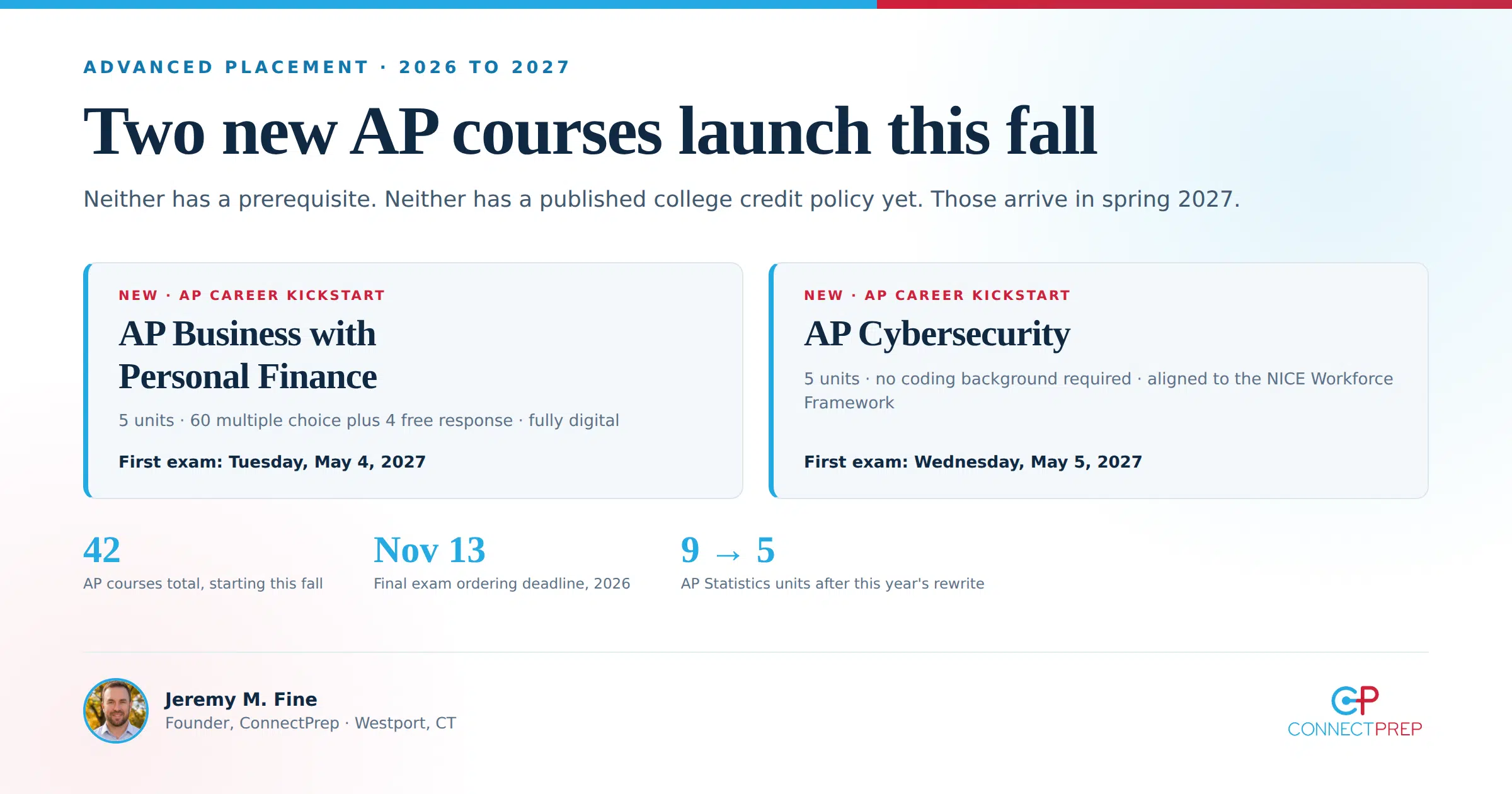
The two new AP courses launching in fall 2026 are AP Cybersecurity and AP Business with Personal Finance. Both come from College Board’s AP Career Kickstart initiative. Both are yearlong courses with no prerequisites, both are fully digital in the Bluebook app, and both carry an employer endorsed credential.
First exams are Tuesday, May 4, 2027 for AP Business with Personal Finance and Wednesday, May 5, 2027 for AP Cybersecurity. No college has published a credit policy for either course yet. College Board says the first policies arrive in spring 2027.
Key Facts
| AP Business with Personal Finance | AP Cybersecurity | |
|---|---|---|
| Launch | Fall 2026, national | Fall 2026, national |
| First exam | Tuesday, May 4, 2027 | Wednesday, May 5, 2027 |
| Prerequisites | None | None, including no coding background |
| Units | 5 | 5 |
| Multiple choice | 60 questions, 70 minutes, 60% | 60 questions, 80 minutes, 70% |
| Free response | 4 questions, 90 minutes, 40% | 1 question, 50 minutes, 30% |
| Delivery | Fully digital, Bluebook | Fully digital, Bluebook |
| College credit policies | None published yet | None published yet |
| Last verified | August 6, 2026 | August 6, 2026 |
What are the two new AP courses for 2026 to 2027?
The two new AP courses are AP Cybersecurity and AP Business with Personal Finance. Both launch nationally in fall 2026 through College Board’s AP Career Kickstart initiative, an effort to build AP courses around career applicable skills rather than traditional academic disciplines. College Board confirmed in March 2026 that the AP program will offer 42 courses starting this fall.
Note the exact name of the second course. Earlier coverage referred to it as “AP Business Principles/Personal Finance.” College Board has since standardized on AP Business with Personal Finance. If a source uses the older name, that source predates the current course materials.
Both courses carry an employer endorsed credential alongside the possibility of college credit, which is a genuinely new element in the AP program. College Board reports that nearly 300 employers and more than 70 local chambers of commerce across more than 40 states endorsed the courses, with industry input from CompTIA, Oracle, IBM, and U.S. Bank.
One more course is worth knowing about. A third AP Career Kickstart course, AP Networking, is in a closed pilot during 2026 to 2027. Only schools that previously participated in an AP Networking or AP Cybersecurity pilot are eligible. AP Networking launches nationally in 2027 to 2028, with its first full exam in May 2028.
What counts as a new AP course versus a recent one
| Course | Launch year | Status |
|---|---|---|
| AP Cybersecurity | 2026 to 2027 | New this fall |
| AP Business with Personal Finance | 2026 to 2027 | New this fall |
| AP Networking | 2027 to 2028 | Closed pilot this year |
| AP African American Studies | 2024 to 2025 | Established |
| AP Precalculus | 2023 to 2024 | Established |
What is AP Cybersecurity?
AP Cybersecurity is a yearlong College Board course covering five units organized around three assessed skill categories: Analyze Risk, Mitigate Risk, and Detect Attacks, each worth 25 to 40 percent of the exam, plus a fourth integrated category called Collaborate. The course framework aligns to the NICE Workforce Framework. There are no prerequisites and no coding background is required.
That last point is the course’s defining design decision. College Board states explicitly that AP Cybersecurity is built for students without prior experience in coding or computer science. This is a deliberate contrast with AP Computer Science A, which effectively assumes a programming background, and it opens the course to a much wider range of students.
Exam structure. Section one is 60 multiple choice questions in 80 minutes, worth 70 percent. Section two is a single free response question in 50 minutes, worth 30 percent. The exam is fully digital in Bluebook.
One honest caution about that structure. College Board has not published a description of what the single free response question asks. A lone question carrying 30 percent of a score is a high variance design, and we would want to see a released sample before advising a student on how to prepare for it.
Industry partnership. Cisco is an official curriculum partner through its Networking Academy. Students in the course can prepare for the Cisco Certified Support Technician Cybersecurity certification alongside the AP exam. Cisco reported in May 2026 that the 2025 to 2026 pilot ran in 183 schools across 30 states with roughly 3,100 students.
What is AP Business with Personal Finance?
AP Business with Personal Finance is a yearlong introductory College Board course covering five units: businesses and competition, marketing, personal saving and borrowing, business finance and accounting, management and strategy, and personal goals, budgeting, and investing. Assessed skills are concept application, entrepreneurship, decision making, communication, and collaboration. There are no prerequisites.
A scheduling detail parents should know. Units one through four are covered before the exam. Unit five, the personal finance capstone on goals, budgeting, and investing, may fall before or after the exam depending on how a school builds its calendar. If personal finance is the reason your student is taking this course, ask the school where unit five sits. It is a fair question and it changes what the year actually looks like.
Exam structure. Section one is 60 multiple choice questions in 70 minutes, worth 60 percent. Section two is four free response questions worth 40 percent, split into part A, one question in 25 minutes, and part B, three questions in 65 minutes. The exam is fully digital in Bluebook.
Unlike AP Cybersecurity, this course had no formal pilot phase. College Board field tested it during 2024 to 2025 and 2025 to 2026 before this fall’s national launch.
Why families come to ConnectPrep for AP planning
ConnectPrep is founder led and one on one. We help students build an AP schedule around what colleges on their list actually reward, not around what happens to be in the course catalog, and we are candid when the answer is that a course is not worth the slot. Backed by more than 20 years of elite test preparation.
Do colleges give credit for the new AP courses?
No college has published an AP credit policy for AP Cybersecurity or AP Business with Personal Finance. This is College Board’s own statement: the first set of institutions granting credit for these exams will be released in spring 2027, which is after students have already completed most of a year in the course. Any website claiming to know today which colleges will grant credit is guessing.
That timing is a real asymmetry and families should price it in.
So what is the course actually worth right now? Three things, in descending order of confidence.
Rigor on the transcript. This is the most reliable value and it is available immediately. An admissions reader sees an AP level course. That signal does not depend on any college’s credit policy.
The employer credential. For a student genuinely interested in the field, the Cisco Certified Support Technician Cybersecurity pathway is a concrete, portable credential. For a student who is not going to major in the subject, that may well be more useful than three college credits.
College credit. Unknown. Treat it as upside, not as the reason to enroll.
If your student wants a course that reliably converts to credit, the established AP courses remain the safer choice. If your student wants the subject itself, the new courses are worth taking on their own merits. What you should not do is enroll in AP Cybersecurity specifically because you expect it to remove a requirement from a college transcript. Nobody can promise that yet.
What changed in AP Statistics for 2027?
AP Statistics has been substantially rewritten, effective the 2026 to 2027 school year, with the first revised exam on Tuesday, May 11, 2027. The former nine unit course becomes five units. The second year algebra prerequisite has been removed. Five content areas were cut. The multiple choice section grows from 40 to 42 questions with four answer choices instead of five, and the free response section drops from six questions worth four points each to four questions worth ten points each.
Here is the contrarian part of this article: the two new courses are getting most of the attention, and for the majority of students the redesigns matter far more. A new course affects students who choose to take it. A redesign affects everyone already enrolled, including students holding a prep book bought last spring that is now wrong.
| What changed in AP Statistics | Detail |
|---|---|
| Course structure | The former nine unit course becomes five units. Units 1 through 8 were consolidated into 5, and Unit 9 was removed entirely |
| Prerequisite | The second year algebra prerequisite was removed. The course is now open to any student who has completed first year algebra |
| Content removed | Five content areas: departures from linearity, combining random variables, the geometric distribution, the chi square goodness of fit test, and all of Unit 9 on inference for slopes |
| Multiple choice | 40 questions becomes 42, and answer choices drop from five to four |
| Free response | Six questions becomes four, and each is now worth ten points instead of four |
| Delivery | Moves from hybrid digital to fully digital in Bluebook |
| First revised exam | Tuesday, May 11, 2027 |
The free response change is the one that matters most and it is getting the least attention. Moving from six four point questions to four ten point questions completely rewrites pacing and partial credit strategy. Under the old structure, a badly handled question cost roughly one sixth of the section. It now costs a quarter. Time allocation, the decision of when to abandon a question, and how aggressively to write for partial credit are all different problems than they were last year.
The dropped algebra prerequisite is the second story. It meaningfully widens who can take the course, which is good for access, and it also means classrooms this year will contain students who would not previously have been in them.
What other AP courses changed this year?
Three other groups of AP courses changed for 2026 to 2027: all six world language and culture courses move fully digital and add a course project, the three AP history exams get a rebuilt free response section beginning May 2027, and AP Music Theory becomes a hybrid digital exam with no change to its structure.
World languages go fully digital and add a project
All six AP world language and culture exams, covering Chinese, French, German, Italian, Japanese, and Spanish, move fully into Bluebook. Paper exams are discontinued. AP Spanish Literature and Culture makes the same move.
The larger change is a new course project drawn from the Unit 3 theme of Art and Creativity, using music as a lens for exploring cultural products, practices, and perspectives. Students submit a Personalized Project Reference, an outline of their presentation, through the AP Digital Portfolio by April 30, 2027. Speaking free response questions are replaced by authentic speaking tasks prepared in advance and completed on exam day.
Practical note: wired headsets with microphones are required. CD players, handheld digital recorders, and the Digital Audio Capture app are no longer used. Confirm equipment with your school well before May.
The three AP history exams get a rebuilt free response section
Beginning in May 2027, AP European History, AP United States History, and AP World History: Modern all change their free response sections.
- Short answer questions: students now answer all three. The choice has been eliminated. Question one includes one or more secondary text sources, question two includes a primary text source, and question three includes a primary or secondary non text source.
- Long essay: one required prompt replaces the previous choice of prompts, with a brief introductory statement to orient students. Arguments must be supported with at least two pieces of specific, relevant evidence.
- Document based question: covers a wider chronological range, so students can draw evidence from across the course.
What has not changed: the multiple choice section, the scoring rubrics, and the course content and skills. That is worth stating plainly, because headlines make this sound more dramatic than it is. The eliminated short answer choice is the change with real strategic consequence, because students can no longer skip their weakest era.
AP Music Theory
AP Music Theory becomes a hybrid digital exam in Bluebook beginning with the 2027 administration, with no change to exam structure. Multiple choice and sight singing responses submit through Bluebook, while free response booklets are still collected on paper. Wired headsets are required and wireless headsets are not permitted.
Who should take the new AP courses?
AP Cybersecurity fits a student with genuine interest in security, information technology, or computing who does not have a programming background. AP Business with Personal Finance fits a student interested in business, entrepreneurship, or economics, and any student who would benefit from structured personal finance instruction. Neither course is worth taking as a schedule filler.
AP Cybersecurity makes sense for a student who would struggle in AP Computer Science A because of the programming assumption. The no prerequisite design is the entire point. It also fits a student who wants a portfolio and credential story rather than a pure grade point average play.
AP Business with Personal Finance makes sense for a student who has run out of relevant business or economics coursework, and for any student who would genuinely benefit from structured personal finance instruction, which describes most seventeen year olds.
Neither makes sense as a schedule filler. If a student is choosing between AP Cybersecurity and a fifth core academic AP that a target college is known to weight, take the core AP. Selective admissions still reads the core curriculum first. For most students, the honest answer is no, a new AP is not worth displacing an established one.
And for any student enrolled in AP Statistics, a world language, or an AP history course this year, the redesign affects them whether or not anyone was paying attention, and the prep materials most families would reach for by default are now out of date. That is the more urgent conversation in most households this month.
AP key dates for 2026 to 2027
| Date | What happens |
|---|---|
| October 2, 2026 | Preferred deadline for AP Exam orders |
| November 13, 2026 | Final ordering deadline. A $40 per exam late fee applies after this date |
| January 22, 2027 | Deadline for accommodations requests through Services for Students with Disabilities |
| March 12, 2027 | Spring course orders and changes to fall orders |
| April 30, 2027 | AP Digital Portfolio deadline for world language Personalized Project References, AP Seminar, AP Research, and AP Computer Science Principles performance tasks |
| May 3 to 7 and May 10 to 14, 2027 | Main exam administration |
| May 17 to 21, 2027 | Late testing |
| July 2027 | Scores released |
November 13 is the deadline families miss. Put it in the calendar now.
Two additional notes. Unused and canceled exam fees are waived for both new courses during 2026 to 2027. And AP Exam start times are being adjusted for some locations beginning in May 2027, so confirm timing with your school.
Frequently asked questions
What are the two new AP courses for 2026 to 2027?
AP Cybersecurity and AP Business with Personal Finance. Both launch nationally in fall 2026 through College Board’s AP Career Kickstart initiative, with first exams in May 2027.
Will colleges give my student credit for AP Cybersecurity?
Not yet determined. College Board has stated that the first list of institutions granting credit for the new AP Career Kickstart exams will be released in spring 2027. Take the course for the subject and the transcript rigor, and treat credit as upside.
Should my student take a new AP course or an established one?
If the choice is between a new course and a core academic AP that a target college weights, take the core AP. If the new course fills a genuine interest and does not displace anything important, it is a good addition.
My child is taking AP Statistics this year. Do we need new materials?
Yes. AP Statistics changed from nine units to five, the exam structure changed, and five content areas were removed. Any prep book written for the previous course will teach material that is no longer tested and drill the wrong exam format. Use College Board’s official materials until third party publishers catch up.
Is AP Cybersecurity hard if my student has never coded?
The course was explicitly designed for students without a coding or computer science background. That is its defining feature. AP Cybersecurity is not a programming course.
When are the first AP Cybersecurity and AP Business with Personal Finance exams?
AP Business with Personal Finance is Tuesday, May 4, 2027, and AP Cybersecurity is Wednesday, May 5, 2027. Both are in session one and both are fully digital in Bluebook.
What is AP Networking and can my student take it?
AP Networking is a third AP Career Kickstart course. During 2026 to 2027 it runs as a closed pilot open only to schools that previously participated in an AP Networking or AP Cybersecurity pilot. It launches nationally in 2027 to 2028.
How many AP courses are there in 2026 to 2027?
42. College Board confirmed this count in March 2026, reflecting the addition of AP Cybersecurity and AP Business with Personal Finance.
The bottom line
Two genuinely new AP courses launched this fall, and both are reasonable choices for the right student, with the honest caveat that the college credit question stays unanswered until spring 2027.
But if your student is already enrolled in AP Statistics, a world language, or an AP history course, the redesigns are the more pressing issue in your house this month. Those changes are live now, they affect the exam your student actually sits in May, and the materials most families reach for by default were written for a course that no longer exists.
Check what your student is enrolled in before you buy a single prep book.
Sources and further reading
- College Board, AP Career Kickstart
- AP Central, AP Cybersecurity course and exam pages
- AP Central, AP Business with Personal Finance course and exam pages
- AP Central, AP Statistics Revisions
- AP Central, AP World Language and Culture Revisions
- AP Central, AP History Exam Updates
- AP Central, 2026 to 2027 Key Dates and Deadlines
- Cisco Learning Blog, AP Cybersecurity partnership, May 2026
Course details compiled from College Board and AP Central and verified August 6, 2026. Confirm current course offerings and exam policies with your school. ConnectPrep revises this page as College Board publishes updates.
Cite or share this article. Counselors, journalists, and school resource pages are welcome to reference this guide with attribution: Fine, Jeremy M. “The Two New AP Courses for 2026 to 2027.” ConnectPrep, August 2026, with a link to this page.
About the author. Jeremy M. Fine is the founder of ConnectPrep and has spent more than 20 years coaching students through high stakes admissions exams. ConnectPrep works with students on AP coursework, SAT and ACT preparation, and college admissions strategy with one on one, founder led instruction. ConnectPrep is based in Westport, Connecticut and works with families throughout Fairfield County and the New York metro area.
Contact: (914) 288-5718 · info@connectprep.com
Building your student’s AP schedule for this year?
We will help you weigh what colleges on your list actually reward, flag which courses changed this year, and build a plan that does not waste a slot.